Fast, Reliable Air Quality & Sanitizing Across Santa Barbara
If you live in Santa Barbara and your home has a recurring musty odor, a smoky smell that lingers long after a Sundowner event, or visible mold near your vents, the source is almost always inside your duct system — not on the surface. Our Air Quality & Sanitizing work in Santa Barbara goes beyond surface cleaning: we treat what’s coating the inside of your trunk lines, flex ducts, and evaporator coil, then verify the results. Call (805) 691-0622 for a free estimate — Patrick is usually available within the week and handles every job personally.
Why Total Air Duct Refresh Santa Barbara Is Santa Barbara’s Preferred Air Quality & Sanitizing Company
Patrick Nelson has been doing this work in Santa Barbara for 14 years — not as a side service attached to a general HVAC company, but as a dedicated air duct and indoor air quality specialist. That depth matters here, where the combination of marine-layer humidity and Sundowner wind events creates contamination patterns that a generalist simply hasn’t seen enough times to diagnose correctly. When homeowners from the Mesa to the Upper State corridor call us, they’re getting the person who answered the phone also arriving at the job with Nikro HEPA-rated extraction equipment and Abatement Technologies air filtration gear — not a rotating subcontractor.
452 Santa Barbara homeowners have left verified reviews averaging 4.9 out of 5 stars. That’s not a statistic we mention casually — it reflects hundreds of distinct residential jobs across ZIP codes 93101, 93103, 93105, and 93108, covering everything from post-wildfire odor remediation on the Riviera to mold treatment inside 1930s Spanish Colonial Revival homes with retrofitted flex ductwork. Customers choose us because Patrick leads every job personally, and because the equipment we bring is the same grade used in commercial remediation work — Rotobrush rotary brush systems, Nikro vacuums, Guardsman EPA-registered sanitizing agents. No corners cut.
Our Air Quality & Sanitizing Services in Santa Barbara
Mold Treatment
Santa Barbara’s Pacific marine layer pushes inland through the Waterfront and Funk Zone most mornings and regularly reaches the Mesa by mid-morning, introducing persistent coastal humidity into low-lying duct systems. Flex ductwork in these areas was sized and sealed under a dry-air assumption, and the result is chronic interior condensation that accelerates mold and mildew growth on aging duct liners — liners that are then never treated before Sundowner season begins. We apply EPA-registered Guardsman antimicrobial treatments directly to interior duct walls after mechanical extraction, targeting the root system of mold colonies rather than masking surface growth.
Post-1925 Spanish Colonial Revival homes on the East Side and Westside present a specific access problem: ductwork was retrofitted through tight attic cavities with no original access panels, which means sanitizing crews working with undersized equipment are forced through suboptimal entry points that leave interior duct walls partially untreated — allowing mold to re-establish within a season. Patrick works through these cramped spaces with purpose-built Nikro extraction tooling designed for exactly these access constraints.

Bacteria Sanitizing
Bacterial colonies thrive in the same moisture-rich duct environments that produce mold, and in Santa Barbara’s older housing stock they’re often found together. Our bacteria sanitizing process uses EPA-registered foggers to deliver an antimicrobial agent throughout the full duct system — supply lines, return plenums, and air handler cabinet — after mechanical cleaning removes the particulate load. This is especially relevant for the 1960s–70s tract homes concentrated in the Upper State and Las Positas corridors, where duct systems may have never received a sanitizing treatment in 50-plus years of continuous use.

Odor Removal
Persistent odors inside Santa Barbara homes fall into two categories: biological (mold, bacteria, rodent activity) and combustion-based (wildfire ash, smoke byproducts from Sundowner-driven fire events). Each requires a different approach. Biological odors respond to mechanical extraction followed by antimicrobial treatment. Wildfire smoke odors — the kind homeowners on Chapala Street and throughout the Riviera have called us about repeatedly since the 2017 Thomas Fire — require extraction of embedded char particulates from evaporator coils and trunk liners before any odor treatment will hold. Masking a smoke odor without extracting the ash source is a temporary fix at best.
We responded to a 1930s Spanish Colonial Revival home on the Riviera where the homeowner reported a persistent smoky, acrid odor weeks after a Sundowner event during a Santa Ynez Mountain fire. Using Nikro HEPA-equipped extraction equipment inside the cramped attic cavity beneath the low-pitched clay tile roof, we pulled char-laden debris from the main trunk line and found the evaporator coil coated in fine ash particulates. We followed the mechanical cleaning with a full bacteria sanitizing treatment and an Aprilaire whole-home air purifier installation. Odor gone. Measured air quality restored. Single service day.

UV Light Installation
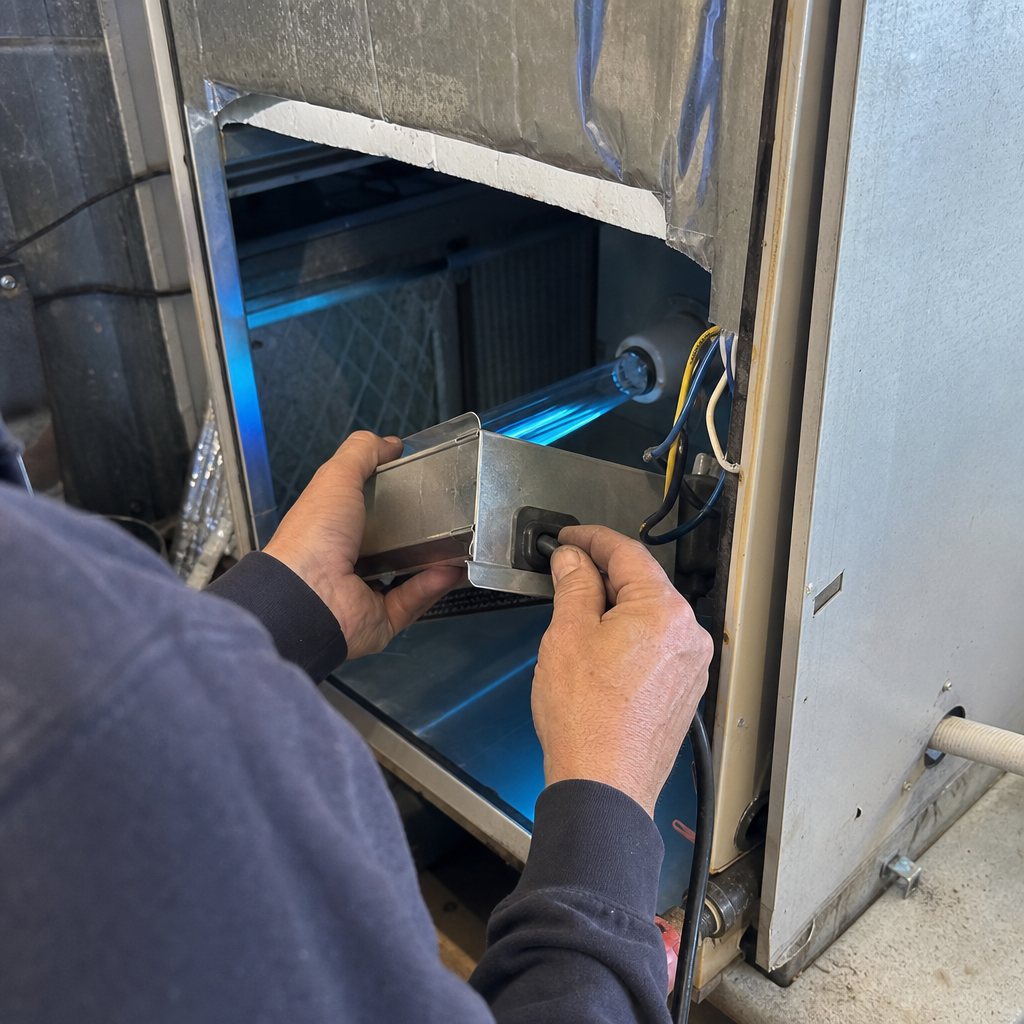
UV germicidal light systems installed inside the air handler cabinet work continuously between service visits, breaking down mold spores and bacteria on the evaporator coil surface before they can circulate through the duct system. For Santa Barbara homes that cycle regularly between high marine-layer humidity and extreme-low-humidity Sundowner events, a UV system adds a layer of ongoing protection that a one-time sanitizing treatment can’t replicate on its own. We install and service Aprilaire and Honeywell UV systems and can advise on which unit is sized correctly for your air handler configuration.

What happens when you call
- 1
A real person answersNo phone trees — you reach a local pro.
- 2
You get an upfront price rangeHonest numbers before anyone is dispatched.
- 3
A background-checked tech heads outLicensed & insured, dispatched right away.
- 4
You approve before work beginsNothing starts until you say go.
Trusted Brands We Service in Santa Barbara
We work with Aprilaire and Honeywell for whole-home filtration and UV light systems, Guardsman EPA-registered antimicrobial products for sanitizing treatments, and Abatement Technologies air filtration equipment for extraction work — the same product lines used in commercial and remediation-grade applications. For Santa Barbara homeowners upgrading from basic filtration to a full indoor air quality system, Patrick can walk through the right configuration for your specific air handler and duct layout, including filter media upgrades that address the dual challenge of wildfire particulates and marine-layer allergens specific to this coastal market.
Common Air Quality & Sanitizing Problems We See in Santa Barbara Homes
- Marine-layer mold in Waterfront and Mesa flex ductwork. Coastal humidity pushes inland daily and settles inside flex duct runs that were never designed to manage sustained moisture exposure. Mold colonies establish on the inner liner and go undetected for years because the duct system looks clean from the outside.
- Wildfire ash contamination in Riviera hillside homes. Attic-mounted air handlers on south-facing hillside properties above downtown pull ash-laden Sundowner air directly through return intakes during Santa Ynez Mountain fire events. Homeowners change their filters and assume the problem is solved — the char particulates coating the evaporator coil and trunk liner remain.
- Partial mold treatment in retrofitted 1920s–1940s duct systems. Spanish Colonial Revival homes throughout Santa Barbara’s historic neighborhoods have ductwork threaded through attic cavities that were never designed for HVAC access. Crews using standard-length tools can’t reach interior duct wall surfaces at turns and transitions, leaving untreated zones where mold re-establishes quickly.
- Chronic musty odor in Upper State and Las Positas tract homes. The 1960s–70s duct systems in these neighborhoods are past their typical service life and have never been sanitized. Biological growth inside old fiberglass duct liner — which absorbs moisture and odors rather than shedding them — produces the low-grade musty smell homeowners often attribute to their carpet or walls.
The Santa Barbara Sundowner Effect — Why Duct Sanitizing Here Isn’t Like Anywhere Else on the Coast
Santa Barbara is the only Southern California coastal city that regularly experiences Sundowner wind events — hot, dry air that roars down from the Santa Ynez Mountains after sunset, driving wildfire smoke and fine chaparral ash directly into home HVAC systems. During a fire event anywhere in the Santa Ynez range, that ash doesn’t just settle on exterior surfaces. It gets drawn through return air intakes — especially on Riviera hillside homes sitting directly in the path of descending wind — and deposits fine char particles on evaporator coils and inside main trunk lines within days. Humidity during these events can crash below 10 percent, which desiccates the particles and embeds them deeper into duct liner surfaces than typical dust ever reaches.
The 2017 Thomas Fire blanketed Santa Barbara in heavy ash for weeks, and the duct contamination we documented in homes from State Street to the upper Riviera that season established a service baseline we still reference. Standard filter changes do not address this contamination. Post-Sundowner duct sanitizing — with mechanical extraction, evaporator coil cleaning, and EPA-registered antimicrobial treatment — is a recurring seasonal service need in Santa Barbara that coastal cities to the south simply don’t experience at the same scale or frequency. If your home sits along Chumash Highway or on any of the Riviera’s hillside streets, this is a real and documented risk to your indoor air quality every fire season.
Pricing for Air Quality & Sanitizing in Santa Barbara, CA
Here are honest ranges for what Santa Barbara homeowners typically pay for each service:
- Mold Treatment (duct interior): $250–$450 for a standard residential system; access complexity in older retrofitted homes can push this higher.
- Bacteria Sanitizing (full system fogging): $150–$300 as a standalone service; typically discounted when combined with a cleaning or mold treatment.
- Odor Removal (wildfire/smoke-related): $300–$600 depending on how deep the char contamination is in the evaporator coil and trunk lines — Riviera hillside homes tend toward the higher end.
- UV Light Installation: $350–$650 installed, depending on the air handler configuration and the Aprilaire or Honeywell unit selected.
- Air Purifier Installation: $400–$900 installed, depending on system type and duct integration requirements.
Most jobs require an on-site assessment before a final quote because access constraints in Santa Barbara’s older housing stock — especially the tight attic cavities in 1920s–1940s Spanish Colonial Revival homes — affect labor time significantly. Estimates are always free. Call (805) 691-0622 and Patrick can usually give you a ballpark range over the phone based on your home’s age and layout before anyone drives out.
We Also Serve Cities Near Santa Barbara
In addition to Santa Barbara, we regularly serve homeowners and property managers in Montecito — where older estate properties share many of the same retrofitted duct challenges as Santa Barbara’s historic homes — and Goleta, where 1970s–1980s tract construction means aging duct systems that have often never been sanitized. Response times to both cities are typically the same as Santa Barbara proper.
Serving Santa Barbara, CA — Our Local Coverage Area
We’re based in the Santa Barbara area and know this community well. Use the map below to see our service coverage — if you’re nearby, we can almost certainly help.
FAQs — Air Quality & Sanitizing in Santa Barbara
Schedule within two to four weeks of significant smoke or ash exposure — don’t wait until the following season. Fine char particulates from Santa Ynez Mountain fire events embed quickly into evaporator coil fins and main trunk liner surfaces, and the longer they remain, the harder mechanical extraction becomes. Waiting also means you’re circulating those particles through your living space every time the system runs. Call (805) 691-0622 after any event where you could smell smoke inside your home with windows closed — that’s your signal the system needs attention.
Yes, and the difference matters. In post-1925 Santa Barbara homes where ductwork was retrofitted through attic cavities that were never designed for HVAC access, standard-length sanitizing tools can’t fully reach interior duct walls at bends and transitions — which leaves untreated zones where mold re-establishes within a season. Patrick works these systems with Nikro tooling configured specifically for restricted-access duct runs, and he’ll tell you upfront where access limitations exist and how we address them. No guesswork about what got treated and what didn’t. Call (805) 691-0622 for a straight assessment.
Almost certainly yes. The Pacific marine layer pushes inland through the Funk Zone and Waterfront area most mornings, and it introduces enough ambient humidity to sustain mold growth inside flex ductwork that was sealed under a dry-air assumption. If the smell is strongest when your HVAC first kicks on in the morning, that’s a classic indicator of biological growth inside the duct liner or on the evaporator coil. A combination of mechanical extraction, mold treatment, and — in persistent cases — a UV light system on the coil will address it at the source. Call (805) 691-0622 for a free estimate.
UV germicidal light systems are highly effective against biological contaminants — mold spores, bacteria, and biofilm on the evaporator coil — but they don’t neutralize wildfire smoke odor on their own. Smoke odor from Sundowner-related ash requires mechanical extraction of char particulates before any treatment will hold. For Upper State tract homes dealing with both seasonal mold and fire-season smoke, the right answer is mechanical cleaning and sanitizing first, then UV installation as an ongoing protective layer. Aprilaire and Honeywell both make units well-suited to the air handler configurations common in 1970s Santa Barbara construction. Call (805) 691-0622 and Patrick can walk through the right sequence for your specific system.
Yes — wildfire ash is not ordinary dust. It contains fine char particles, combustion byproducts, and in the case of chaparral and structure fires, potential chemical residues that standard filtration media isn’t designed to capture. These particles are also significantly finer than typical household dust, which means they penetrate deeper into evaporator coil fins and duct liner surfaces. Left in place, they continue to off-gas odor and degrade air quality every time the system cycles. For Santa Barbara homes that took heavy exposure during events like the 2017 Thomas Fire — or during any subsequent Santa Ynez Mountain fire season — duct sanitizing with HEPA-grade extraction is a different service category than routine cleaning. Call (805) 691-0622 for a direct assessment of what your system actually needs.
If your Santa Barbara home has been through a fire season, carries a persistent musty smell, or simply hasn’t had its duct system treated in years, call (805) 691-0622 to schedule a free estimate. Patrick leads every job personally — you’ll get a straight answer about what’s inside your duct system and exactly what it will take to fix it.
Written by Patrick Nelson, Owner at Total Air Duct Refresh Santa Barbara, serving Santa Barbara since 2011.